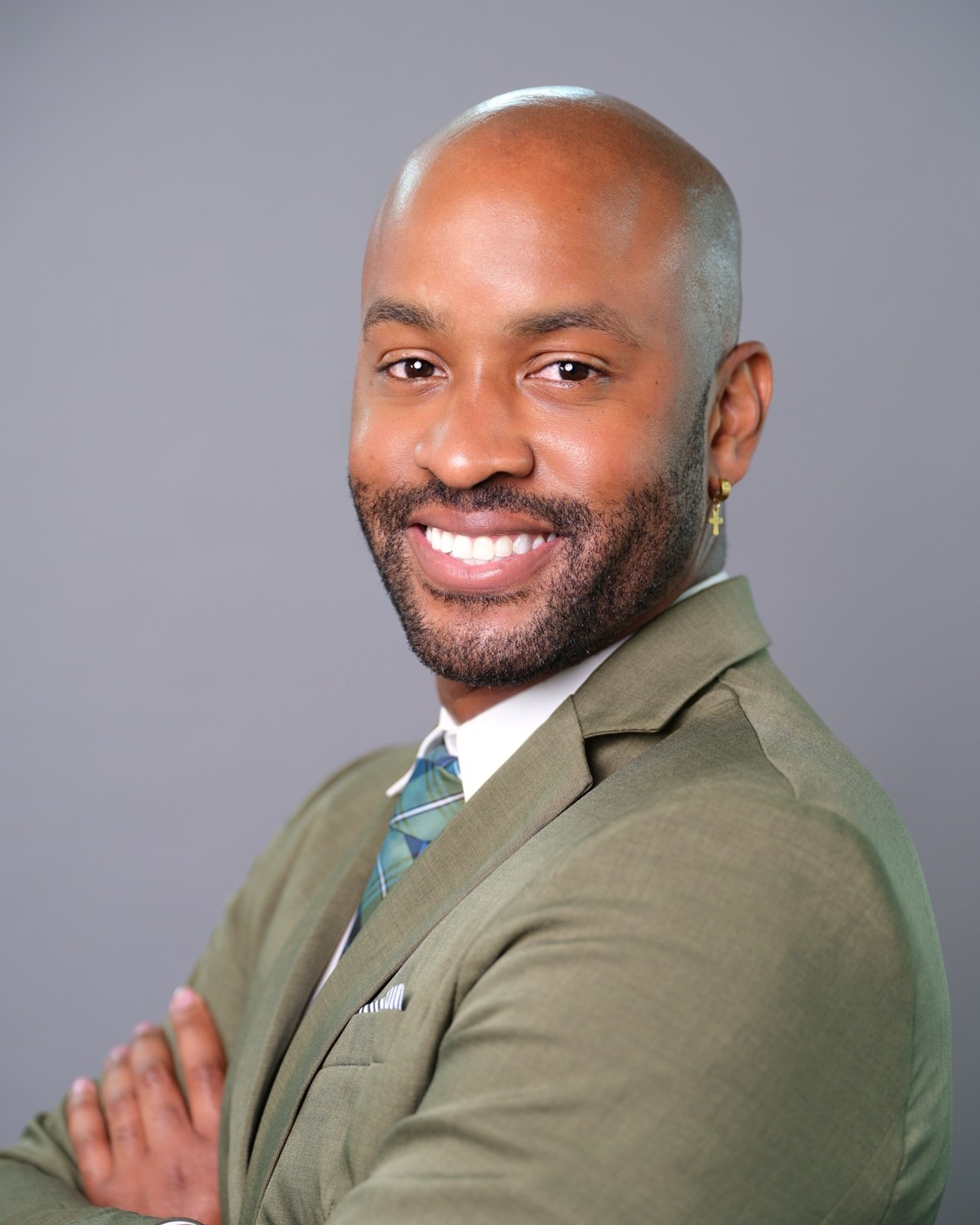
Event Headshots
A headshot lounge is a working photo studio built inside your event: real lighting, a real photographer, and a finished professional headshot in the attendee's hands within a few minutes. Attendees line up for it because a good headshot is worth money to them and most people have not had one taken in years. Organizers book it because, unlike a tote bag, it produces a named opt-in lead from every guest — and because a sponsor will often pay for the whole thing.
We ran one for four days at the BIO International Convention in San Diego, underwritten by Fujifilm, with a three-person crew and more than a thousand headshots delivered. This is what we learned that the brochures leave out.
Three things get called the same thing, and they are not the same product.
The difference the attendee feels is direction. Most people do not know what to do with their hands, and a photograph of someone who is uncomfortable looks like a photograph of someone who is uncomfortable. A lounge has a person whose job is to fix that in about ninety seconds.
The honest answer is that professional headshots are expensive and slightly intimidating to arrange, so people put it off for years. A conference removes both problems. The photo is free, it is fifty feet away, and they are already dressed for it.
That is why the line forms and stays formed. It is also why the lounge tends to outperform every other giveaway on the floor: the attendee leaves with something they will actually use, on the profile that their industry looks at.
There are three models, and which one you pick changes how the booth is designed.
Operators publish full-day activation rates in roughly the $2,500 to $7,500 range, with hourly options below that for short windows. The spread is driven by show length, expected volume, how much custom branding is involved, and whether the crew is local or travelling.
Travel is the line item organizers forget. A crew flying in brings rented bodies and lenses as carry-on and ships the printer, paper, backdrop and signage ahead to the hotel — that shipping, the rental window, and the room nights are real costs that a local crew simply does not have. If two quotes are far apart, this is usually why.
We scope every event individually rather than publishing a rate card, because a half-day at a 300-person association meeting and four days on a convention floor are not the same job.
This is where most planning goes wrong, so here are real numbers.
A single staffed station photographs roughly 25 to 35 people per hour once it is warm. Call it 90 to 120 seconds in front of the camera and two to three minutes end to end including the review and the handoff. Over a full show day that is 150 to 250 attendees per station.
Our BIO lounge delivered more than 1,000 headshots across four show days — around 250 to 300 a day — from one station with a three-person crew.
Here is the part nobody tells you: the printer is not your bottleneck. The Fujifilm Frontier DX400W we ran outputs a 4×6 in 9.4 seconds, about 380 prints an hour. That is ten times the throughput of the camera. The queue is limited by the photographer and by how long people take to settle, never by the hardware.
The practical consequence: if you need more volume, you add a station — photographer, lighting, and space — not a faster printer. And if your quote scales the print hardware but not the crew, the quote is wrong.
Work backwards from the share of attendees you expect to participate. At a business event where the lounge is well signposted, a useful planning figure is that a meaningful minority of attendees will use it — not all of them, and not a handful. Take your expected participants, divide by 200 per station-day, and that is your station count. Round up if the show has hard peaks around keynotes and lunch, because a queue that forms at 12:15 does not care about your daily average.
Short version: about a 10×10 footprint at absolute minimum, more like 10×20 for comfortable flow, nine feet of ceiling, one dedicated 15-amp circuit, and reliable connectivity for digital delivery. At full load — lights, two computers, printer, and a hotspot — expect a 400 to 600 watt draw.
The full checklist, including the questions to ask exhibitor services before you sign the floor plan, is in the booth requirements checklist.
Both, and for different reasons.
The print is the thing that makes the line form. A physical 4×6 handed over warm is a keepsake, and if it carries a sponsor's logo, that logo goes home in someone's bag and onto a desk.
The digital file is the thing that gets used. It goes on LinkedIn that evening, which is where the sponsor's reach actually compounds. Delivery by email, SMS, or an on-booth QR code — we used SpotMyPhotos at BIO — is also the moment the opt-in is captured cleanly.
Skip the print and you lose the queue. Skip the digital and you lose the afterlife.
Every guest opting in before their photo is what turns an amenity into a sponsorship asset. It is also the thing most likely to sour the experience if you overreach.
A short, honest opt-in at the front of the queue converts almost everyone. A mandatory ten-question survey gating someone's own photograph converts far fewer and produces worse data, because people type nonsense to get past it. If a sponsor pushes for a long form, the productive counter is that the headshot itself is the reason the lead is warm — the form is not what makes it valuable.
Whatever you collect, the attendee should know who is getting it before the shutter fires.
Four days is long enough for everything to surface.
It works when your attendees have professional profiles they care about — associations, industry conventions, recruiting events, sales kickoffs. It works best when there is a sponsor who wants to be seen as useful rather than loud.
It works less well at consumer events, at shows where attendees are in costume or casual dress, and anywhere the floor plan cannot give you a quiet corner with a real power drop.
If you are weighing it against another amenity, the test we would apply is simple: which one does an attendee still have next month?
We built the Headshot Lounge and have run it on a convention floor for four days straight. If you are scoping a show, tell us about it — we will come back with a plan, and if it fits, ideas for a sponsor to underwrite it.
A shoot, a campaign, or a headshot booth that draws a crowd — start the conversation.
Get in touch